
Achieving RMF compliance doesn’t have to be a last-minute scramble before an audit. The 90-Day RMF Hygiene Sprint offers a structured, repeatable approach to move from fire drills to steady-state readiness. This three-phase process focuses on cleaning up your artifacts, strengthening your processes, and validating your system for audit readiness. By the end of 90 days, you’ll have a cleaner, more sustainable compliance strategy that supports continuous monitoring.
What You’ll Achieve by Day 90:
- A clean, current POA&M with no lingering “zombie” milestones.
- A standardized evidence library that doesn’t require digging through endless folders.
- Validated narratives where SSPs and control statements reflect actual practice.
- A mock-assessed package ready for external scrutiny.
- A repeatable cadence to maintain compliance every quarter.
This sprint is ideal for GovCon security leaders, ISSMs, ISSOs, PMs, IT teams, and anyone tired of chaotic, all-hands compliance pushes.
Why a Sprint Approach Works
Many teams treat RMF compliance like a marathon, leading to burnout and “document debt.” A sprint approach flips the script by breaking the process into short, focused efforts with clear finish lines. This method builds momentum, ensures clarity, and provides visibility to stakeholders. It’s not about rushing; it’s about working with structured intensity.
Benefits of a Sprint Approach:
- Clarity: Clear objectives and deliverables for every phase.
- Momentum: Early wins keep the team engaged.
- Visibility: Stakeholders get actionable updates, not vague progress reports.
- Agility: Allows for quick pivots when risks emerge.
The 90-Day Plan at a Glance
The sprint is divided into three distinct phases, each with specific goals and outputs. Here’s what the journey looks like:
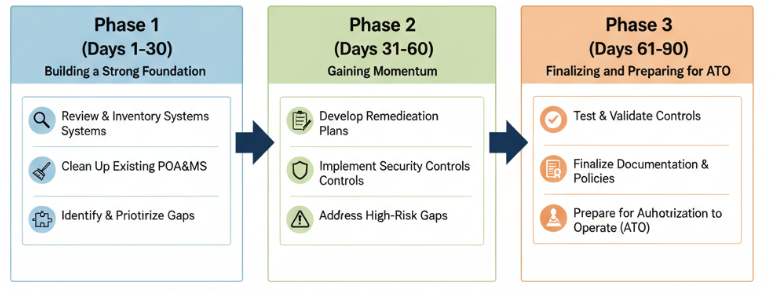
Phase 1: Foundation (Days 1–30)
This phase focuses on stabilizing and organizing the team’s compliance efforts.
Key Activities:
- Triage and clean up your POA&M by closing completed items, eliminating duplicates, and assigning ownership.
- Standardize evidence collection with a clear naming convention and folder structure.
- Conduct a light gap analysis to identify high-impact issues.
Outputs by Day 30:
- A cleaned-up POA&M with clear owners and next steps.
- A structured evidence library everyone can use.
- A prioritized list of gaps ranked by risk and effort.
The goal here isn’t perfection—it’s about gaining visibility and setting a foundation for success.
Phase 2: Building Momentum (Days 31–60)
With a solid foundation in place, this phase emphasizes steady execution and process improvement.
Key Activities:
- Address prioritized gaps, starting with low-effort, high-value fixes like policy updates or minor configuration tweaks.
- Work on larger technical changes, such as expanding MFA or fixing logging pipelines.
- Refine processes to prevent recurring findings (e.g., update scan schedules, standardize ticket workflows).
- Keep the team aligned through regular check-ins and clear accountability.
Outputs by Day 60:
- Noticeable progress in closing high-risk POA&M items.
- Documented process improvements that address root causes of findings.
- An evidence library populated with up-to-date artifacts.
Consistency is key in this phase. By maintaining a steady rhythm, the team avoids stalling out mid-cycle.
Phase 3: Final Polish (Days 61–90)
The final phase focuses on validation and packaging for external review.
Key Activities:
- QA your documentation to ensure narratives align with evidence, versioning is consistent, and references are accurate.
- Conduct a mock assessment, testing controls as an auditor would, and log any findings for follow-up.
- Assemble the ATO submission package using agency-approved templates, ensuring it tells a clear story of risks, mitigations, and readiness.
Outputs by Day 90:
- A fully QA’d set of documents and evidence.
- Results from the mock assessment, with any remaining gaps documented.
- A complete ATO package ready for review.
This phase is all about preparation and confidence. By the end, the team should feel ready to face external scrutiny with minimal anxiety.
How This Aligns with RMF
The 90-Day Hygiene Sprint complements RMF by embedding operational rhythm into its lifecycle:
- Prepare/Monitor: Establish repeatable processes for evidence collection, metrics, and ownership.
- Implement/Assess: Close gaps, validate controls, and test your system like an assessor would.
- Authorize: Assemble and present a clear narrative of risk management, backed by solid evidence.
Instead of treating RMF as a once-a-year panic event, this sprint ensures continuous readiness.
Avoiding Common Pitfalls
Every compliance process has its risks, but this sprint helps you avoid common failure modes:
- Trying to fix everything at once in Phase 1: Focus on visibility and standards first.
- Poor evidence organization: Ensure every artifact answers what control it supports, what system it covers, and when it was created.
- Misaligned narratives and reality: Test early to ensure what’s documented reflects what’s happening.
- Lack of ownership: Assign clear owners for every task or control.
The result: Sustainable security (not just checked boxes)
By Day 90, you haven’t just “done RMF.” You’ve built a system: clean artifacts, clear ownership, repeatable cadence, and confidence backed by evidence.
Then you do what high-performing teams do: you run the cycle again, but faster and calmer—because the foundation is already there.
If your current RMF status feels like a familiar sense of dread, start with Day 1: clean up that POA&M and standardize evidence. Momentum shows up quickly when the work stops hiding.
Let’s get to work. (And yes, this counts as cardio.)
Frequently Asked Questions
What is an RMF Hygiene Sprint?
A 90-day cadence that stabilizes RMF artifacts, executes prioritized remediation, validates evidence through testing, and packages results for audit/ATO readiness—then repeats for continuous monitoring.
How often should we run a hygiene sprint?
Quarterly is a strong default. If you’re in heavy change or recovering from findings, run it back-to-back until the POA&M and evidence baseline are stable.
What makes a POA&M “clean”?
Every item has an owner, a due date, a status that reflects reality, and a link to evidence (or a clear plan to produce evidence). No duplicates, no dead items, no “TBD forever.”
What evidence should we standardize first?
Start with evidence that’s frequently requested and easy to drift: access reviews, vulnerability/patch reporting, log review artifacts, change approvals, backups/restores, incident handling records, and training completion.
What does a mock assessment actually look like?
A structured sampling of controls where you test the control claim against real artifacts and traceability (tickets/logs/approvals). If you say you do it weekly, you show multiple weeks—no exceptions, no interpretive dance.
What’s the fastest way to get rejected on an ATO submission?
Submitting the wrong template, missing required attachments, or providing inconsistent narratives vs evidence. Packaging quality signals operational maturity—like it or not.