
TL;DR
- Low-cost AI allows small and medium-sized businesses (SMBs) to access capabilities previously limited to large enterprises.
- The primary challenge is no longer budget but the need for clear governance and usage policies.
- This inflection point requires leaders to establish a secure approach for integrating AI into workflows.
- SMBs can use this shift to modernize operations, improve efficiency, and strengthen their competitive position.
- The goal is to leverage AI’s benefits while managing risks to data security and operational consistency.
Artificial intelligence has shifted from a technical concept to a practical, accessible tool. Recently, OpenAI recently accelerated this trend by launching ChatGPT Go at a significantly lower price point (read more at The Verge). Because subscription costs have dropped to around $8 per month, budget is no longer the primary barrier to adoption. Instead, the new challenge centers on the ease with which any team member can integrate these tools into professional workflows using a personal credit card.
Consequently, this shift creates a new reality for SMB owners. AI will likely enter your workflows whether or not an official plan exists. While adoption is inevitable, the speed of this change represents the true inflection point. Furthermore, OpenAI’s plan to introduce ads for free and low cost tiers will only accelerate this trend. For business owners, this means that establishing clear governance is now an urgent priority.
Why Low-Cost AI Matters for SMBs
When a powerful software tool costs less than a monthly coffee budget, it falls below the typical procurement threshold. Employees often do not need to seek formal approval to use it. This creates two potential futures for your business operations.
Future A: Uncontrolled AI Adoption
- Tool Sprawl: Different departments adopt various AI tools without coordination, leading to inconsistent outputs and wasted resources.
- Inconsistent Communications: Customer-facing messages lack a unified tone and message, creating a disjointed brand experience.
- Data Exposure: An employee might paste sensitive client information or internal data into a public AI tool “just this once,” creating a significant security risk.
- Lack of Traceability: When an auditor or a customer asks for a record of how a decision was made, no one can explain which processes involved AI.
Future B: AI with Lightweight Controls
- Approved Tools: The company uses a small, vetted set of AI tools that meet security and privacy standards.
- Clear Data Rules: Everyone understands what information is confidential and must never be entered into public AI models.
- Human Review: A policy requires human oversight before any AI-generated content is sent externally or used for official reporting.
- Basic Documentation: Simple records are kept, allowing you to defend operational decisions and maintain audit readiness.
The competitive advantage is not simply using AI. It is using AI to improve efficiency without introducing operational chaos.
The Practical Upside: Where Affordable AI Delivers Value
For most owners, the goal is not abstract innovation. It is reducing the hours spent on low-value, repetitive work. Affordable AI can help achieve this quickly in several areas.
1. Buy Back Time Without Adding Headcount
AI can handle drafting and summarization tasks that consume valuable time. This frees up your team to focus on higher-value work that requires human judgment.
Low-risk wins include:
- Drafting internal emails and preparing first drafts of client communications for review.
- Turning unstructured meeting notes into clear action items and owner assignments.
- Summarizing long email threads or documents to identify key decisions and next steps.
The metric for success here is simple: hours saved per week and a reduction in follow-up meetings.
2. Improve Response Speed and Consistency
AI excels at producing consistent first drafts and maintaining a specific tone. For teams handling customer communications at scale, this can improve both quality and speed. The rule of thumb should be clear: AI drafts, and a human decides and approves.
3. Reduce Reporting Friction
Operational reporting can become a routine task instead of a last-minute fire drill. AI can assist in summarizing non-confidential operational data and creating repeatable templates. This makes the reporting process more predictable and less disruptive.
The Risks Owners Feel (and How to Mitigate Them)
While the benefits are tangible, the operational risks are just as real. Understanding them is the first step toward effective management.
1. Data Leakage and Trust Damage
Public and consumer-grade AI tools may use your inputs to train their models. OpenAI’s policies state that its individual services may use content for training unless a user opts out. If an employee pastes customer data or confidential business information into the wrong tool, the cost is not the $8 subscription. It is the loss of customer trust and potential regulatory penalties.
Owner takeaway: The most important control is a clear rule: do not enter confidential information into public AI tools.
2. Shadow IT Becomes “Shadow AI”
Low-cost plans make it simple for employees to bypass IT approval and compliance checks. This uncontrolled adoption of tools means you cannot manage what you do not know about.
Owner takeaway: If you cannot list the AI tools your team is using, you cannot manage your AI-related risk.
3. Over-Automation Without Oversight
Automating external emails, updating official records, or generating final reports without human review is a recipe for expensive errors. Small mistakes can scale quickly when automated.
Owner takeaway: Implement a default requirement for human review on all external-facing or system-of-record outputs.
4. Sharper Social Engineering Attacks
Phishing and business email compromise attempts are becoming more sophisticated with the help of AI. An urgent-sounding request involving payments, credentials, or client data requires extra scrutiny.
Owner takeaway: Add a second verification step for any high-risk action. A phone call or in-person check is a simple and effective control.
The Missing Piece: A Simple Policy for Cheap AI
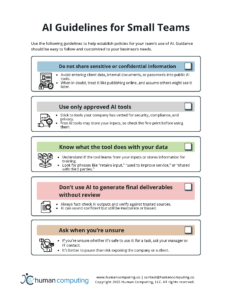
Most SMBs do not need a lengthy, enterprise-grade governance program. AI Guidelines for Small Teams can help to provide governance when presented as a job aid. It is an easy way to ensure adherence to your AI policy.
This brings us to the policy itself: You need a simple policy that establishes minimum guardrails and reduces confusion. This document should be easy to understand and implement.
That is why we are sharing a free, customizable AI Acceptable Use Policy template. You can adapt and publish it in under 30 minutes. It is based on practical guidelines for small teams:
- Do not share sensitive or confidential information.
- Use only approved AI tools.
- Understand what tools do with your data.
- Do not use AI outputs as final deliverables without review.
- Ask when you are unsure.
Download the free AI Acceptable Use Policy template to establish clear rules for your team.
A Practical Rollout Plan for SMBs
You can establish lightweight governance in about 30 days.
- Week 1: Establish the Foundation. Publish your one-page AI policy. Designate a single person (e.g., in Operations, IT, or Security) to own approvals and answer questions.
- Week 2: Run Low-Risk Pilots. Choose one or two workflows that do not involve sensitive data. Focus on drafting, summarization, or creating internal templates.
- Week 3: Measure and Refine. Track the time saved and any errors or rework required. Use feedback to clarify your policy with more specific examples.
- Week 4: Scale and Contain. Expand the use of AI for workflows that have proven successful. For any process that touches customer data or regulated information, ensure it uses business-grade tools with appropriate controls. OpenAI’s business offerings, for example, do not use customer data for training by default.
Final Guidance for Owners
The $8 AI tier does not just make AI affordable. It makes its presence inside your business unavoidable. The SMBs that gain a durable advantage will be those that act with intention.
Success comes from a disciplined approach:
- Pick a few low-risk, high-impact workflows to start.
- Set clear rules on approved tools and data handling.
- Keep humans in the loop for review and approval.
- Document just enough to stay audit-ready without slowing down.
The subscription is cheap. The operational clarity you create is priceless. Your future self will thank you for establishing a policy before you need it.
Note: This template provides operational guidance, not legal advice. If you operate in a regulated environment, align your policy with legal counsel and your specific contractual requirements.
FAQ
What is the “$8 AI inflection point”?
The “$8 AI inflection point” refers to the availability of affordable AI tools, such as ChatGPT Go, that cost as little as $8 per user per month. This price point lowers the barrier for small and mid-sized businesses (SMBs) to adopt AI, making powerful AI capabilities accessible to organizations with limited budgets.
How could cheap AI impact SMBs?
Affordable AI can help SMBs streamline workflows, enhance customer service, and automate repetitive tasks, leading to increased efficiency and reduced costs. However, it also introduces risks, such as improper data handling, lack of governance, and potential security vulnerabilities if not managed carefully.
What are the primary risks associated with using low-cost AI tools?
Key risks include data leakage, accidental sharing of sensitive or proprietary information, misaligned outputs that could impact decision-making, and a lack of accountability when AI errors occur. Additionally, overreliance on AI without clear controls can expose businesses to compliance risks in regulated industries.
How can SMBs prepare for AI adoption while managing risks?
Start by establishing clear usage policies for AI tools, including guidelines for data handling, approval processes for AI-generated outputs, and steps to monitor accuracy. Ensure that compliance and governance processes are adjusted to include AI use and align with regulatory or customer requirements.
When should SMBs consult legal or compliance experts?
SMBs in regulated industries, such as healthcare or finance, should consult legal or compliance experts early, before implementing AI systems. This ensures that AI adoption aligns with applicable laws, contractual obligations, and industry-specific requirements.
What are the immediate next steps for SMB leaders interested in adopting AI?
Define the specific business problems you aim to solve with AI, and evaluate affordable tools like ChatGPT Go for fit and effectiveness. Monitor early use cases closely to identify risks or areas for improvement, and create a simple governance framework for AI use. Start small and scale once you establish confidence in the process.
Why is early governance for AI so important?
Adopting governance early prevents potential pitfalls like data misuse and operational errors. It also builds trust among customers and stakeholders by demonstrating that the business is taking responsible steps to manage AI risks proactively.