
I recently came across a compelling piece by cybersecurity expert Dan Lohrmann titled, 2025: The Year Cybersecurity Crossed the AI Rubicon. In it, he argues that we’ve reached a point of no return where AI is now the driving force behind modern threats. While his analysis paints a sobering picture of the global landscape, it got me thinking about what this ‘Rubicon’ moment looks like for those of us running small businesses on Main Street. If the rules of the game have changed, how do we change our playbook?
The term “Rubicon” historically refers to a point of no return. It is a moment when a critical decision or action alters the course of events irreversibly. For cybersecurity and AI, crossing the Rubicon symbolizes the era where artificial intelligence has become deeply embedded in both defensive and offensive strategies. This shift means that traditional approaches to risk management and defense are no longer sufficient. It requires businesses to rethink their strategies and adapt to a world where AI sets the pace. For small and midsized businesses, understanding this inflection point is crucial to staying competitive and resilient.
2025: Why Leaders Have Crossed the Rubicon in Secure Modernization
The phrase “crossing the Rubicon” originates from Julius Caesar’s bold decision in 49 BCE to lead his army across the Rubicon River, defying Roman law and the Senate’s orders. This act marked the point of no return, triggering a civil war that transformed Rome from a republic to an empire. Today, it symbolizes irreversible decisions and bold actions that can redefine the future, offering a powerful metaphor for businesses navigating critical choices in a rapidly changing world.
For the cybersecurity industry and the businesses it protects, 2025 was that year. We have crossed the Rubicon.
For the last decade, Artificial Intelligence was largely a marketing buzzword. It was a promise of future efficiency or a vague threat on the horizon. Security leaders discussed it in theoretical terms. We debated ethics and timelines. But in 2025, the theory ended. AI became the primary operational tool for both attackers and defenders.
The barrier to entry for sophisticated cyberattacks collapsed. Tools that once required state-sponsored funding or advanced coding skills became available to anyone with a subscription. Hackers leveraged Large Language Models to write flawless phishing emails. They used voice synthesis to impersonate executives. They automated the discovery of vulnerabilities at a speed no human team could match.
This shift does not mean we are helpless. It means the playbook has changed. The strategies that protected small and mid-market businesses in 2023 and 2024 are insufficient today. We must acknowledge this new reality to defend against it. This guide outlines the specific changes in the threat landscape and provides three executable steps to secure your organization in the AI era.
The New Reality: Why have the Old Rules Failed?
For years, organizations trained employees to look for specific red flags in emails. Standard advice was to check the sender’s email address carefully and spot for poor grammar, spelling mistakes, or awkward phrasing. These security measures relied on the fact that attackers were often working across language barriers or rushing their work.
Those indicators are gone.
Generative AI has democratized perfect syntax. An attacker can now feed a few public emails from your CEO into a model and generate a request that mimics their tone, cadence, and vocabulary perfectly. They can do this in any language. They can do it at scale.
The Death of “Good Enough” Verification
The operational risk here is significant. In the past, a rushed employee might click a link because they were busy. Now, a focused and diligent employee might click a link because it looks legitimate. The deception is perfect.
This fundamentally breaks the “human firewall” concept as we knew it. We cannot expect employees to detect fraud through intuition when the fraud is mathematically designed to bypass human intuition.
Speed and Scale
The second change is velocity. Automated agents can scan your perimeter, identify a misconfiguration, and attempt an exploit in seconds. This happens 24 hours a day. There is no downtime. As a result, manual patch management cycles that take weeks are now a critical liability. In essence, the window between vulnerability discovery and exploitation has shrunk from days to minutes.
The “Human” Shield: Deepfakes and Social Engineering
As we move through the rest of the decade, the primary threat to small business owners is no longer just malware. It is advanced social engineering powered by deepfakes.
By 2026, we expect deepfake audio and video to be the standard mechanism for high-value fraud. This is not science fiction. It is the natural evolution of Business Email Compromise (BEC).
The Evolution of Wire Fraud
Consider the standard wire fraud scenario. In the past, an attacker hacked an email account and watched the inbox. When an invoice came in, they intercepted it and changed the routing number.
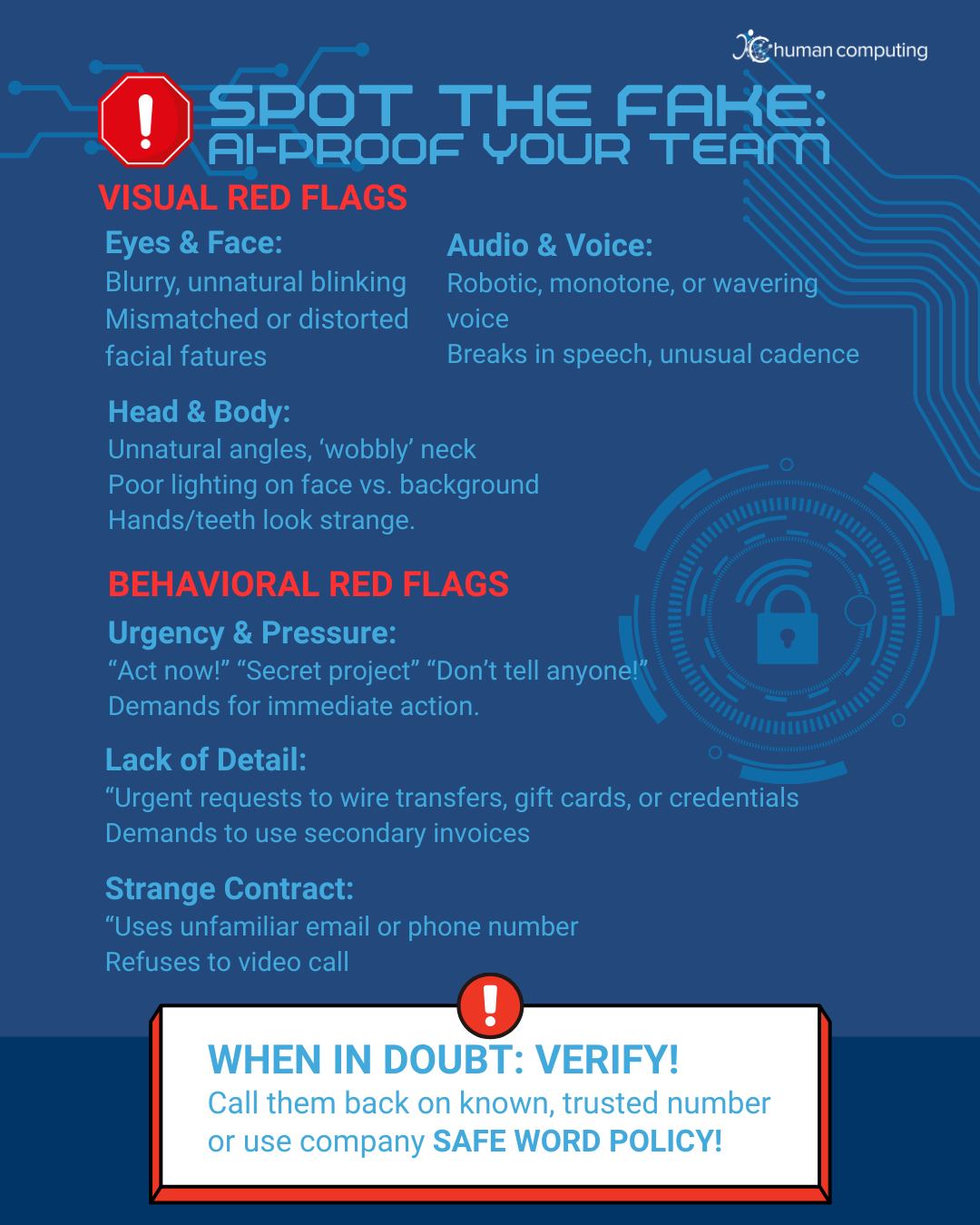
In the AI era, the attacker does not need to hack the email. They can call the Controller. The voice on the phone sounds exactly like the CFO. The caller ID is spoofed to match the CFO’s number. The “CFO” explains that there is an urgent merger acquisition that requires an immediate transfer. They might even suggest a video call to confirm. On that video call, the attacker uses real-time face swapping technology to appear as the CFO.
The Psychological Impact
This attacks the employee’s desire to be helpful and responsive. It leverages authority and urgency. When the sensory input (sight and sound) confirms the identity of the requestor, the employee’s skepticism vanishes.
This puts your finance and operations teams in an impossible position. They are being asked to distrust their own eyes and ears. Without a governance framework to support them, they will default to compliance. They will send the money.
Action Step 1: The Safe Word Policy
The defense against high-tech deception is often low-tech validation. Since we can no longer trust voice or video implicitly, we must establish a verification layer that AI cannot replicate easily. We need a “Safe Word Policy.”
This is a form of two-factor authentication for human-to-human communication. It creates a protocol where high-risk requests require a secondary confirmation code that is known only to specific internal parties.
How It Works
The concept is simple. The leadership team and key finance or operations personnel agree on a secret word or phrase. This word is never written in email. It is never shared on Slack or Teams. It is memorized.
When a request comes in that triggers a risk threshold—such as a wire transfer over a certain amount, a change to payroll data, or a request to send sensitive employee files—the requestor must provide the Safe Word.
If the “CEO” calls the Controller and demands an urgent wire transfer, the Controller simply asks, “Can you please verify the Safe Word?”
If the caller is an AI bot or a human hacker using voice synthesis, they will not know the word. The caller might guess. Some may react with anger and claim they are too busy for games. Others may simply hang up. In any of these scenarios, the Controller knows to halt the transaction immediately.
Implementation Protocol
To make this executable, you need a documented Standard Operating Procedure (SOP).
- Selection: Choose a random word or phrase. Avoid common terms.
- Distribution: Share it verbally in a face-to-face meeting or a secure, encrypted voice call.
- Scope: Define exactly when it is required. Do not overuse it, or it will lose its security value.
- Rotation: Change the word annually or immediately if an employee with knowledge of it leaves the company.
This costs nothing to implement. It requires no software installation. Yet, it provides a robust defense against the most sophisticated AI-driven social engineering attacks.
Action Step 2: AI-Powered Defense
While low-tech solutions protect against social engineering, you need high-tech solutions to protect your infrastructure. You must fight AI with AI.
Legacy antivirus (AV) solutions are no longer sufficient. Traditional AV works by looking for “signatures.” These are known snippets of code that identify a specific virus. If the AV sees the signature, it blocks the file.
AI-driven malware can rewrite itself. It can change its code structure with every iteration to avoid signature detection. It behaves like a virus in the biological sense, mutating to survive.
Endpoint Detection and Response (EDR)
To counter this, regulated businesses must deploy Endpoint Detection and Response (EDR) or Managed Detection and Response (MDR) tools.
These tools do not rely solely on signatures. They use behavioral analysis and machine learning. They look at what a program does, not just what it looks like.
- If a calculator app suddenly tries to connect to the internet and download a file, EDR flags it.
- If a Word document tries to run a PowerShell script, EDR stops it.
- If a user account logs in from three different countries in one hour, EDR locks the account.
The Speed Advantage
The critical advantage of modern EDR is speed. When an AI-driven attack occurs, it moves laterally through a network in minutes. A human security team cannot analyze the logs fast enough to stop it. An AI-powered EDR agent can isolate the infected machine instantly.
This containment capability is the difference between a minor incident and a catastrophic ransomware event. For executives, the decision is a transfer of risk. You are transferring the burden of detection from a human analyst to a machine learning model that never sleeps.
Action Step 3: Culture of Verification
Tools and policies are useless if the culture undermines them. The final action step is to build a “Culture of Verification.”
In many organizations, speed is the ultimate metric. Employees are praised for responsiveness. They are encouraged to clear their inboxes quickly. In this environment, asking a senior executive to verify a request feels like insubordination. It feels like slowing the business down.
You must flip this dynamic. Verification must be viewed as a competence, not a nuisance.
The “No-Penalty” Policy
Leadership must explicitly state that no employee will ever be penalized for verifying a request, even if it turns out to be legitimate.
- If a junior employee challenges the CEO on a wire transfer request, that employee should be praised.
- If a manager pauses a project launch to confirm a vendor change, that manager is protecting the asset.
This requires visible reinforcement. When someone catches a phishing email, share it. When someone uses the Safe Word correctly, acknowledge it.
Standardizing Skepticism
You can operationalize this by creating standard channels for verification. If an urgent text message comes in from the CEO, the standard procedure should be to call the CEO on their known mobile number or message them on an internal platform like Teams.
Make this a documented workflow. “If request comes via Channel A, verify via Channel B.” When this is written in an SOP, it removes the personal awkwardness. The employee is not questioning the boss’s authority. They are simply following the approved process.
Bonus: The “Safe Word” Policy Template
AI attacks rely on speed and complexity, but a safe word provides a simple, shared defense. This protocol bridges the gap between evolving technology and human trust.
You can adapt the following section for your internal policy documents to establish a clear purpose and protocol for using a shared secret.
Safe Word Policy Standard
- Purpose: To prevent unauthorized funds or data transfers resulting from impersonation, deepfake audio, or compromised accounts.
- Protocol: Any request involving wire transfers over $5,000, changes to vendor banking details, or the release of sensitive data must be verified verbally using the current safe word.
- Failure State: If the requestor cannot provide the safe word, the transaction must stop immediately. The employee must then contact the Security Officer through a separate, verified communication channel.
- Management: The safe word is stored in a restricted password manager vault. Rotate your safe words quarterly and never transmitted them via unencrypted email or text.
This governance artifact turns a high-level concept into an audit-ready control. It provides your team with clear permission to pause and protect the organization.
You can quickly and easily protect your financial assets from AI-driven fraud at no cost. We have developed a two-page Safe Word Policy Template that you can distribute to your team today.
Conclusion
The shift toward advanced AI has created a clear turning point. Decisions made now will define your operational security for years to come. We cannot return to a time before deepfakes or when email was inherently trustworthy; the threat landscape has evolved permanently.
This shift is not a cause for panic. It is a call for discipline. You already have the tools to defend your organization. Modern EDR handles technical velocity. A Safe Word Policy handles deception.
Let this be the article that inspires action. Consider gathering your leadership team, establishing an internal Safe Word, and empowering your employees with “permission to pause.” Taking these steps today can help turn cybersecurity from a challenge into a strength. It shows your clients and partners that you’re a resilient, forward-thinking operator in an ever-changing world.
Ready to start? Download our Safe Word Policy Template and secure your business in less than 10 minutes.
To help you better understand the implications of crossing the AI Rubicon and how it impacts small business security, we’ve compiled a list of frequently asked questions along with practical answers and actionable advice.
Frequently Asked Questions
What is the AI Rubicon in cybersecurity?
The AI Rubicon in cybersecurity refers to the critical inflection point where artificial intelligence (AI) becomes both a powerful tool for innovation and a significant vector for risk. On one side, AI enables enhanced threat detection, predictive analytics, and automation that improve security outcomes. On the other, malicious actors exploit AI to create more sophisticated attacks, such as deepfake phishing, automated vulnerability discovery, and scalable social engineering. Crossing this Rubicon means the balance of power shifts, requiring organizations to fundamentally adapt their risk management strategies to address the dual-edged nature of AI. For small and mid-market businesses, this often involves adjusting governance to include AI-specific controls, embedding AI resistance into workflows, and preparing for emerging threats that do not follow traditional attack patterns. Addressing the AI Rubicon is no longer optional; it is essential to modern resilience.
How can organizations prevent deepfake fraud?
Preventing deepfake fraud requires a layered approach that combines clear policies, training, and technology. One effective strategy for small businesses is implementing a Safe Word Policy. This policy introduces a pre-agreed, confidential phrase used during high-risk verbal or visual transactions, particularly those involving financial requests or sensitive data. When an imposter attempts to impersonate an executive or vendor, the absence of the safe word acts as a clear red flag. Businesses should supplement this policy by educating employees on suspicious patterns and using tools for voice and video verification. By embedding these practices into daily workflows, organizations strengthen their defense against evolving AI threats while maintaining operational efficiency.
Are AI-generated emails detectable in 2026?
By 2026, the detection of AI-generated emails has shifted from spotting telltale signs like grammatical errors or typos to focusing on verifying the identity of the sender. Modern generative AI tools have advanced to the point where their output can mimic human communication with precision, eliminating once-reliable indicators of inauthenticity. Instead, organizations are prioritizing authentication measures such as email filtering systems that verify sender metadata, domain trustworthiness, and behavioral patterns. Implementing DMARC protocols, multi-factor validation practices, and anomaly detection have become standard in identifying suspicious communications. This shift underscores the importance of identity validation over content analysis, ensuring that communication security adapts to the sophistication of AI technologies without disrupting workflows.
What is a Safe Word Policy, and why is it important?
A Safe Word Policy is a simple procedure where specific code words or phrases are used to verify the authenticity of requests, especially in high-risk scenarios. It is crucial because it mitigates AI-driven fraud by ensuring team members can confidently validate critical actions and prevent scams.
Does implementing a Safe Word Policy require any tools?
No, implementing a Safe Word Policy does not require any tools. It involves setting clear guidelines and providing your team with the agreed-upon code words or phrases. This zero-cost process can be established within minutes by using a simple template, such as the one provided above.
Is it safe to use “cult movie” safe words, and is it risky?
Using “cult movie” references or other easily recognizable terms as safe words poses significant risks. While they may seem creative or memorable, their familiarity makes them susceptible to guessing or social engineering attacks. Attackers leveraging AI-driven tools can quickly identify popular phrases, slogans, or references, allowing them to bypass such weak authentication measures. Additionally, culturally specific or niche references might confuse team members who are unfamiliar with them, introducing unnecessary delays or errors in critical moments. Effective safe words should be random, unique, and not easily associated with known media or trends, ensuring that they remain secure and reliable in high-risk scenarios.
What makes a “Strong Word” safe?
A strong safe word is designed to reduce ambiguity and maintain security during high-risk events. We recommend using a two-noun method to create these words. Select two unrelated, common nouns such as “Magnet Cedar” or “Anchor Tulip.” This approach avoids patterns, common phrases, and pop culture references that attackers might guess or compute.
These two-noun combinations are easy to pronounce and distinguish audibly. This ensures clarity and prevents miscommunication when teams must act quickly. The words are short enough for rapid delivery but unique enough to remain unmistakable. Rotating these noun pairs regularly reduces the risk of exposure and ensures the process remains a reliable part of your security operations.
How do criminals use AI to commit financial fraud?
AI can mimic voices, generate convincing phishing messages, or create fake identities to deceive victims. These techniques are known as deepfakes and social engineering attacks, making it easier for fraudsters to impersonate trusted individuals or manipulate processes to steal financial assets.
How can small businesses stay prepared for AI-driven threats?
Small businesses can stay prepared by raising awareness, implementing policies like the Safe Word Policy, and training employees on how to identify potential scams. Regularly reviewing security practices and staying updated on evolving threats are also key steps to reducing risk from AI-driven attacks.
How effective is a Safe Word Policy in preventing fraud?
A Safe Word Policy is highly effective as a first line of defense. By introducing a verification step into key workflows, it reduces the likelihood of successful impersonation or unauthorized actions. While not foolproof, it significantly deters fraud by creating barriers that AI tools cannot easily overcome.